First Pool, First Worker: A Beginner's Evening of Setup and First Credits
Joining a mining pool for the first time is mostly plumbing: an account, a worker name and a stratum address. A modest 426 TH/s starter unit produces near 0.00019111 BTC each day at present difficulty, about $16.19 gross or $15.54 after the listed pool charge. Follow the sequence below and the first hourly credits land before bedtime.
Key takeaways
- 426 TH/s yields close to 0.00019111 BTC daily, valued at $16.19 gross at $84,692 per BTC.
- The listed 4% on the block-reward component trims that to roughly $15.54 a day.
- PPS+ settlement, the default, credits the block-reward share every hour against current difficulty.
- Solo mining at 426 TH/s would need absurd patience, while a pool pays for every valid share.
Why a pool at all when the machine mines alone
A single ASIC hashing by itself faces the whole network as an opponent. With total throughput around 1,003 EH/s, a lone 426 TH/s box holds a microscopic slice, and the wait for a self-found block stretches past any reasonable horizon. The often-quoted illustration makes the point: even 100 TH/s would expect a block only once in about 190 years. Pooling converts that lottery ticket into a wage.
The mechanism is simple division of labor. Thousands of machines submit shares, the pool finds blocks regularly with their combined weight, and each contributor is paid for the shares it submitted. Your coins arrive in small hourly pieces instead of one enormous prize that never comes. For a newcomer, that steady cadence is also an education: every credit confirms the setup is correct.
Scale helps the intuition. The network creates 144 blocks a day at 3.125 BTC of subsidy each, 450 BTC in total. One all-in-one multi-coin pool serves users across 150-plus countries with over a million accounts, so blocks arrive on its side frequently enough to smooth individual payouts. The beginner's job is only to connect cleanly and stay connected.
Opening the account and naming the first worker
Registration asks for little: an email, a password and a payout address from the built-in wallet or an outside one. Inside the dashboard, create a worker, which is just a named login the machine uses to identify itself. Call it something descriptive such as garage-unit-01, because a year from now that label is the only memory of which box earned what.
Point the miner at the pool's stratum address for BTC, using the worker name and a simple password. Most firmware accepts this in under five minutes, and the dashboard usually shows the worker as active shortly after the first shares arrive. If the status stays dark after fifteen minutes, the usual culprits are a mistyped address, a firewall rule or a pool URL pasted with an extra space.
Newcomers sometimes land on ViaBTC Bitcoin Mining pages while comparing pools, and the details worth comparing are settlement choice, listed charges and payout history rather than slogans. Check that the dashboard shows hashrate near the machine rating before celebrating. A worker reporting half its rated speed from the first minute usually has a loose network cable or a overheating board.
What the first night of credits looks like
Under the default PPS+ settlement, the block-reward portion pays hourly against current difficulty, so credits begin accumulating the same evening. At 426 TH/s the daily figure is 0.00019111 BTC, which divides into about 0.00000796 BTC per hour. Six hours after a clean start, expect roughly 0.0000478 BTC on the ledger, worth near $4.05 at $84,692.
Do not stare at the dollar column. Price moves during the night while the coin column climbs in a straight line, and beginners who watch dollars conclude the machine is broken when only the market moved. Judge the setup on coins per hour for the first week. Dollars matter at withdrawal time, not at 2 a.m.
The pool's statistics view adds context once the basics feel stable. It shows pool and network hashrate side by side with difficulty, currently 132.76 T, so the relationship between personal slice and global total becomes visible. A network overview page of that kind turns abstract millions of exahashes into a single readable ratio.
Growing from one box to a small row
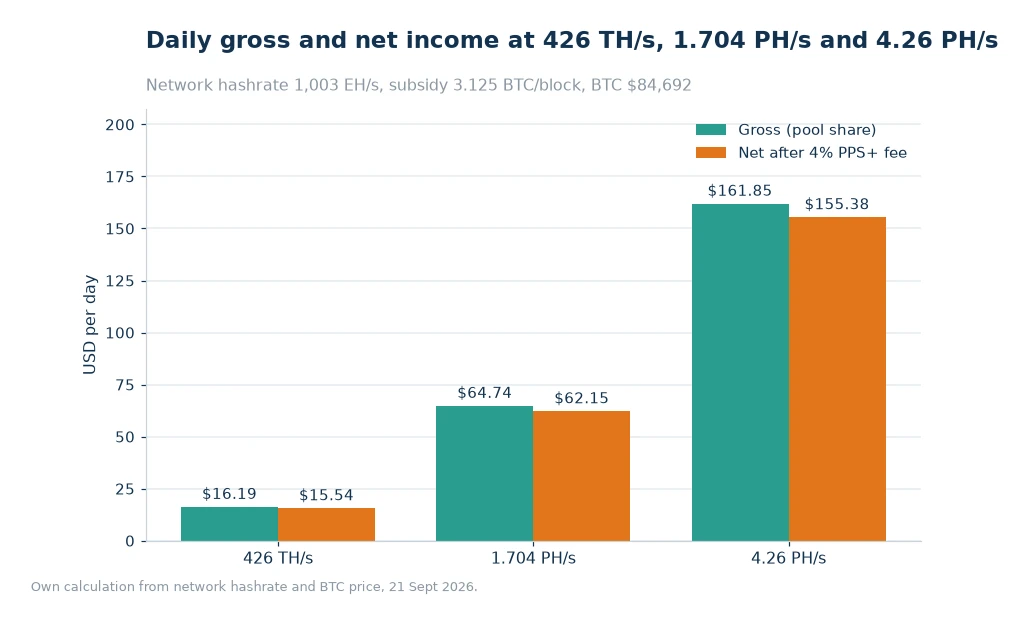
Many starters add a second machine within months, and the chart below anticipates that path with three rungs: 426 TH/s, 1.704 PH/s and 4.26 PH/s. Income scales in a straight line with hashrate at fixed difficulty, so four times the machines means four times the coins before charges. The table states the same ladder in monthly terms for anyone planning power capacity.
| Rung | BTC per month | Gross per month | Net per month |
|---|---|---|---|
| 426 TH/s starter | 0.00573330 | $485.70 | $466.20 |
| 1.704 PH/s shelf | 0.02293320 | $1,942.20 | $1,864.50 |
| 4.26 PH/s row | 0.05733180 | $4,855.50 | $4,661.40 |
Power planning decides whether the second box is sensible. A machine's draw in watts multiplied by 24 hours and the local kilowatt-hour price gives the daily cost to hold against the daily credit. At $0.06 per kWh, even a power-hungry unit leaves margin at these coin figures, but at $0.15 the margin thins fast. The Miner Profitability Ranking lists current models side by side so a buyer can compare efficiency before ordering.
Picking the coin for the opening month
Bitcoin is the natural first choice because the setup path is the best documented and the strategy guides cover every step, but the account supports more than twenty coins, so alternatives stay available without new logins. Litecoin with merged DOGE mining appeals to owners of Scrypt hardware, while KAS suits those who bought its specific algorithm. The rule for month one is simple: point the hardware at the coin it was built for and resist exotic switching until the baseline is solid.
Resist the urge to chase whichever chart spiked yesterday. At starter sizes the difference between coins rarely exceeds the cost of a misconfigured afternoon, and every switch resets the learning curve on a fresh stratum address. A single month of uninterrupted BTC credits at 426 TH/s teaches worker hygiene, payout rhythm and power discipline that transfer to any coin later. Breadth can wait; depth pays first.
When curiosity persists, paper-trade the alternative instead of pointing hardware at it. Look up the network figures, run the same division of personal share times daily issuance and compare the dollar line honestly against the $16.19 BTC gross. Most comparisons end with the miner returning to the original worker, which is itself a valuable lesson bought for nothing.
Worked example
Run the full chain for the 426 TH/s starter. Daily BTC per TH/s equals 450 divided by 1,003,000,000, which is 0.00000044865. Multiply by the machine: 426 times 0.00000044865 gives 0.00019112 BTC, matching the chart value of 0.00019111 BTC a day within rounding. Convert at $84,692: 0.00019111 times 84,692 equals $16.19 gross. Apply the listed 4% on the block-reward component: $16.19 times 0.96 equals $15.54 net. The largest rung checks the same way: 4.26 PH/s is 4,260 TH/s, times 0.00000044865 gives 0.00191106 BTC a day, times 84,692 equals $161.85 gross, times 0.96 equals $155.38 net.
Frequently asked questions
How long until a new worker shows earnings?
Usually the first hour. Under PPS+ the block-reward share settles hourly, so a correctly connected 426 TH/s machine shows about 0.00000796 BTC after its first full hour.
Is one machine enough to bother with a pool?
Yes, that is exactly what pools are for. A lone 426 TH/s box would essentially never find a block alone, but in a pool it earns near 0.00019111 BTC a day for its shares.
When should a beginner consider a second machine?
After a full month of stable operation with the power bill in hand. If the first unit held its rated hashrate and the daily $15.54 net covered power with room to spare, the same setup scales linearly.
Lock in the routine and let the hours stack
Check the worker status each morning for a week, then relax into a weekly glance. Keep firmware updated, keep the intake dust-free and keep the payout address current. Mining rewards patience more than tinkering, and the hourly staircase does the rest one credit at a time.
Sources: ViaBTC homepage, statistics and fee pages for settlement rhythm and the listed 4%; support guides for worker setup. Chain inputs read 21 Sept 2026: network hashrate about 1,003 EH/s, difficulty 132.76 T, 3.125 BTC subsidy per block, 144 blocks daily, BTC $84,692. Published 11 Nov 2026; figures assume continuous uptime[1].