RTA Kitchen Cabinets: Start With the Layout
A kitchen is a set of runs before it is a set of doors, and the run arithmetic decides how much cabinet you actually get. The clearest comparison is inside one price: the 42-inch base sells for $586.28 and holds 20.13 cubic feet of gross envelope, while the 30-inch base sells for the same $586.28 and holds 14.38. The same money buys 40% more box.
Key takeaways
- Base cabinets are 34-1/2 inches high and 24 inches deep in every width from 9 to 42 inches, so width is the only variable in a run.
- A 42-inch base and a 30-inch base both cost $586.28, but the 42-inch holds 20.13 cubic feet against 14.38.
- Dollars per cubic foot fall from $40.78 at 30 inches to $29.13 at 42 inches in the same price band.
- Corner and blind base cabinets absorb the geometry that a straight run cannot, at $528.87 and $412.62.
The run comes before the door
Almost every guide to buying starts with style. That is the wrong end of the decision, because a layout that does not close cannot be rescued by a finish. Start with the runs: the straight lengths between fixed objects, measured at the floor and again at counter height, since walls lean and corners are rarely square.
Each run is a queue. The range, the sink, the refrigerator and the doorway are fixed blocks that cannot be moved by choosing a cabinet, so they are subtracted first. What remains is filled with standard widths. A buyer who starts with a finish ends up reversing a decision later, either by paying for a filler that was not planned or by accepting a smaller cabinet than the gap allowed.
Thinking in runs also makes the budget legible. A run has a length, a set of widths and a total price, and every one of those numbers is published before you order. The finish changes the price per box but not the number of boxes, so it belongs at the end of the process rather than the start.
Volume is the honest measure of a base cabinet
Door count is a poor proxy for storage. A double-door base and a single-door base can look similar on a plan and hold very different amounts, because the box behind the front is what stores things. The gross envelope is width × height × depth, and for base cabinets the height and depth are fixed at 34-1/2 and 24 inches. Only the width moves.
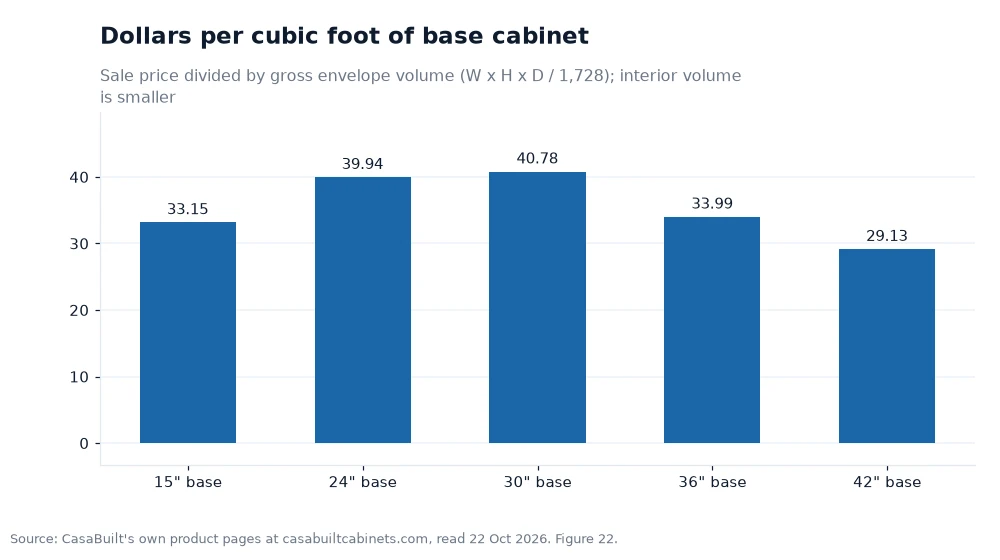
That makes the comparison clean. A 15-inch base is 7.19 cubic feet of envelope, a 24-inch is 11.50, a 30-inch is 14.38, a 36-inch is 17.25 and a 42-inch is 20.13. Divide each published sale price by its volume and the pattern appears: $33.15, $39.94, $40.78, $33.99 and $29.13 per cubic foot.
The peak sits at 30 inches, not at the small end. That is the opposite of what most buyers expect, and it comes from the price steps rather than from the boxes: the 30, 36 and 42-inch cabinets share one $586.28 price, so the rate falls as the box grows. A run built from 30-inch cabinets is the most expensive way to buy volume in this group; a run built from 42-inch cabinets is the cheapest.
| Width | Published configuration | Sale price | Gross volume | Dollars per cubic foot |
|---|---|---|---|---|
| 15 in | Single-door, single-drawer base | $238.24 | 7.19 cu ft | $33.15 |
| 24 in | Double-door, single-drawer base | $459.26 | 11.50 cu ft | $39.94 |
| 30 in | Double-door, double-drawer base | $586.28 | 14.38 cu ft | $40.78 |
| 36 in | Double-door, double-drawer base | $586.28 | 17.25 cu ft | $33.99 |
| 42 in | Double-door, double-drawer base | $586.28 | 20.13 cu ft | $29.13 |
Corners and the leftover inches
A run that turns a corner is two runs meeting, and the meeting point is where layouts fail. Corner base cabinets are published at $528.87 for 33 to 36 inches, and blind base cabinets at $412.62 for 33 to 39 inches. Both exist because the cabinet in the corner has to give up its front to the cabinet beside it, and a standard box cannot do that without a filler or a blank panel.
Straight runs have their own leftover problem. Widths step in 3-inch increments from 9 to 42, so a 100-inch run filled with three 30-inch cabinets leaves 10 inches, which is a filler and a visible seam. The fix is to plan the largest cabinets first and let the remainder land on a width that exists, rather than choosing a pleasing sequence and discovering the gap at the end.
Height and depth deserve the same attention. Base cabinets are 24 inches deep, vanities are 21, and wall cabinets are 12. A wall cabinet above a 24-inch base leaves a 12-inch difference in projection, which is normal and useful, but a vanity ordered at base depth will stand proud of the wall line by 3 inches. The published depth is part of the layout, not a detail to confirm later.
Four passes to a layout that quotes cleanly
First pass: measure every wall at floor level and at counter height, and write down the ceiling height and the window sill height. Second pass: block the fixed objects, including the range, the sink centerline and the refrigerator, which needs its own cabinet above and space beside it. Third pass: fill each run with standard widths, starting with the largest boxes and working down. Fourth pass: check the total against the budget before choosing a finish. Most buyers who shop for rta kitchen cabinets work through those passes in the opposite order, which is why finish decisions so often arrive before the widths are settled.
The fourth pass is where a free design service earns its place. CasaBuilt offers a 3D kitchen design in 24-48 hours, and a design drawn from your measurements will show the fillers, the corner treatment and the door swings that a width list hides. It will not fix a measurement, so the numbers going in still have to be right.
The design-to-budget estimator is useful at the same stage, because it turns a cabinet list into a range before the finish is chosen. Do that before ordering samples, since there is no point falling for a door on a layout that will not fit the budget.
Worked example: what the 42-inch box really costs
The chart reports five rates. Rebuild two of them from the chart's own inputs: a 42-inch base is $586.28, and its gross envelope is 42 × 34.5 × 24 = 34,776 cubic inches. Divide by 1,728 to convert to cubic feet: 34,776 ÷ 1,728 = 20.125, which the chart rounds to 20.13. Then $586.28 ÷ 20.125 = $29.13 per cubic foot.
Do the same for the 30-inch: 30 × 34.5 × 24 = 24,840 cubic inches, and 24,840 ÷ 1,728 = 14.375 cubic feet. The price is the same $586.28, so $586.28 ÷ 14.375 = $40.78 per cubic foot. The gap between the two rates is $40.78 − $29.13 = $11.65 per cubic foot, on identical money.
The volume gap is 20.125 − 14.375 = 5.75 cubic feet, and 20.125 ÷ 14.375 = 1.4, so the 42-inch box holds 40% more. Put five 42-inch bases along a wall and you have spent $2,931.40 for 100.63 cubic feet; five 30-inch bases cost the same $2,931.40 for 71.88 cubic feet. The difference is 28.75 cubic feet, which is roughly two more 30-inch cabinets of storage that the first layout never paid for.
Frequently asked questions
Should I plan the layout before choosing a door style?
Yes. The layout fixes the number and width of cabinets, and the finish only changes the price of each box. Planning widths first also exposes fillers, corner treatments and appliance clearances while they are still cheap to change, rather than after a door style has been ordered.
Why use gross volume instead of interior volume?
Because gross volume is the only figure that can be derived from published dimensions without assumptions about panel thickness. Interior volume is smaller, since shelves, drawer boxes and the box walls take up space. The rate is a comparison tool between cabinet sizes, not a promise of usable shelf space.
Is a 42-inch base always the best value?
It is the lowest cost per cubic foot in this group at $29.13, because it shares the $586.28 price with the 30 and 36-inch boxes. It still has to fit the run, clear the door swings and suit the room. Value per cubic foot and suitability are separate tests.
Draw the runs, then price the boxes
Sketch each wall as a line, mark the fixed objects, and fill the gaps with the largest standard widths that fit. Price the list before you look at a finish, and check the fillers and the corner cabinet while the layout is still on paper. Then order samples, because the last decision should be the one that is easiest to reverse.
Figures quoted here come from the manufacturer's own website, read 22 Oct 2026[1].