Phenolic Film Panels: How to Read the Specification Sheet
A film-faced specification sheet looks thin until you try to compare two of them side by side. Five fields carry most of the price and almost all of the performance: size format, film type and weight, core species, adhesive class and thickness. A complete sheet for formwork plywood states all five, and the published range gives buyers a template for the questions worth asking.
Key takeaways
- Read the film weight before the film colour — 165 g/㎡ and 130 g/㎡ are two different products.
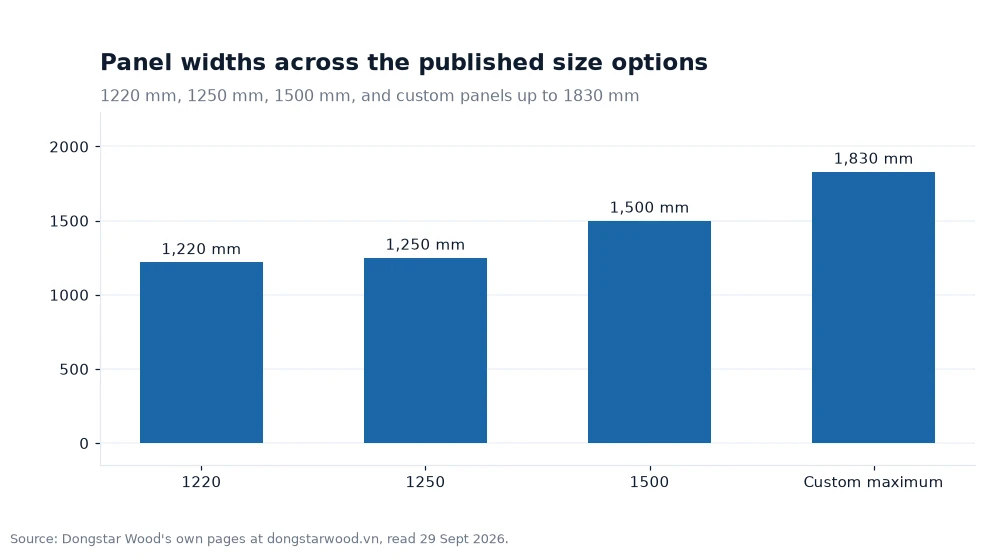
- Size windows run from 1220 × 2440 mm to a custom maximum of 1830 × 3830 mm.
- Six core options are published, so a core code on the sheet is a real specification, not a marketing line.
- Ask for the adhesive class in writing; the list spans E0, E1, E2, MR, WBP and Phenolic Dynea.
Start with the five fields that set the price
Two quotations for the same sheet size can differ by a wide margin, and the difference almost always sits in fields the buyer skimmed. Film weight is the first: a heavier phenolic film carries more resin, survives more concrete contact and costs more to press. Film type is the second, because anti-slip surfaces are a distinct product line rather than a surface finish option.
Core species and adhesive class come next, and they decide what happens when the panel gets wet rather than how it looks on delivery. Thickness is the last field and the one procurement teams fix first, which is precisely the wrong order — a 21 mm panel on the wrong core is still the wrong panel.
Size formats and what "custom" means here
Published formats cover the 1220 × 2440 mm, 1250 × 2500 mm and 1500 × 3000 mm, with customised panels up to a maximum of 1830 × 3830 mm. For formwork layouts, the choice usually follows the shuttering design rather than the sheet: a wall panel grid built around 1250 × 2500 mm wastes less offcut than one built around 1220 × 2440 mm, but only if the mills quoting you run that format at volume.
Custom sizes are worth requesting when a project repeats. A one-off odd size adds press setup work for a single order; the same size specified across a whole floor of pours is a different commercial conversation. Contractors buying Film Faced Plywood for a repeating layout normally fix two formats and treat every other size as an exception, which keeps the panel pool interchangeable between floors.
Film weight, film colour and the mould face
The published film weights are 165 g/㎡ for a smooth surface and 130 g/㎡ for the lighter option, and the films offered are Dark Brown Film, Black Film and Anti Slip Film. Colour is largely a site convention; weight is the technical variable. Heavier phenolic film resists abrasion from aggregate and pumping equipment for longer, which is what the reuse figure depends on.
Where the specification calls for grip — inclined formwork, walkways, platform decks — the anti-slip surface changes the product rather than the finish list, and it is pressed as a separate line with its own size and thickness window.
Two practical consequences follow from the film line. First, a quotation that names a film colour but no weight cannot be compared against another quotation with any confidence, because the resin content behind the colour is the variable that decides wear. Second, film weight and thickness interact: the heavier phenolic film is normally paired with the 18 mm and 21 mm builds used for repeated pours, while the lighter film suits panels that will be handled once or twice.
| Field | Options published | Why it changes the price |
|---|---|---|
| Size format | 1220 × 2440; 1250 × 2500; 1500 × 3000 mm; custom to 1830 × 3830 mm | Press setup and offcut on the shuttering layout |
| Film | Dark Brown Film, Black Film, Anti Slip Film | Surface preparation and the number of pours supported |
| Film weight | 165 g/㎡ smooth surface; 130 g/㎡ | Resin content, abrasion resistance, reuse cycles |
| Thickness | 18 mm for heavy formwork; 21 mm and above for high loads | Core volume and load-bearing capacity |
| Core and adhesive | Birch, Eucalyptus, Acacia, White Hardwood, Rubber, Combi; E0, E1, E2, MR, WBP, Phenolic Dynea | Density, stability and moisture performance |
Cores and adhesives: the two lines buyers skim
Six cores are published, and each answers a different priority. An Acacia core is the heavy-duty option, with high strength and load-bearing capacity for a long service life. Eucalyptus delivers maximum strength and high compression resistance, which suits dense, highly loaded shuttering. A Combi core mixes hardwood and softwood, or eucalyptus with acacia, weighing strength against weight and cost.
Adhesive class decides whether the panel tolerates a wet site. WBP and Phenolic Dynea appear in the published list alongside E0, E1, E2 and MR, and the wording of the order should name the class rather than a general claim about weather resistance.
Worked example: contact area from a single panel
Begin with the sheet. A 1250 × 2500 mm sheet measures 3.125 m² of surface. Its smaller relative, 1220 × 2440 mm, is 1.22 m by 2.44 m, so 2.98 m², and the custom maximum of 1830 × 3830 mm gives 1.83 m by 3.83 m, so 7.01 m².
Example only: with published reuse of 10–20 cycles for high-grade film-faced panels, one 1250 × 2500 mm sheet delivers 10 × 3.125 = 31.25 m² of contact surface on a conservative sequence, and 20 × 3.125 = 62.5 m² if the panel reaches the top of that range. A 40-sheet order therefore covers 40 × 31.25 = 1,250 m² of formed concrete at minimum, which is the number to put beside your floor plan.
Reuse cycles and the edge routine that protects them
Reuse is a maintenance result rather than a property of the sheet. Published guidance puts high-grade film-faced panels at 10–20 cycles in concrete pouring, and the panels that reach the upper end are the ones with sealed edges, cleaned faces and a release agent applied before each pour, not after a problem appears.
Storage matters as much as handling. Packs stacked flat on pallets, away from standing water and out of direct sun, hold their shape between pours; packs leaning against a fence in the rain do not, whatever the film weight.
Frequently asked questions
Which format should a first shuttering order use?
Match the format to the layout grid rather than to the mill's stock list, then check that the chosen size sits inside the published window from 1220 × 2440 mm up to the custom maximum of 1830 × 3830 mm. A layout that repeats a single format generates less offcut than a mixed one.
Is a heavier film always worth the extra cost?
It is worth it where the formwork face is reused repeatedly or handled roughly on site. High-grade panels quoted at 10–20 reuse cycles are the ones built with the heavier 165 g/㎡ film, while the 130 g/㎡ option fits shorter programmes and lighter surfaces.
What should be written into the purchase order?
Five lines: size and thickness in millimetres, film type and weight, core species, adhesive class, and the surface finish on each face. Add the inspection items you expect to see recorded — panel thickness consistency and core construction integrity are the standard pair.
Where the specification goes next
Take the completed sheet to the panel ranges and compare it against the drawings rather than the brochure. Contractors pouring slip-resistant decks can check the mesh-textured panel variant next, while furniture and interior projects usually belong on the general panel range, which publishes its own thickness and glue guidance.
The specification values quoted in this article are published on the manufacturer's own pages, checked on 29 September 2026 and used throughout this article and used throughout this article and carried into this comparison[1].