Can a Period Underwear Manufacturer Meet Your Customization Needs?
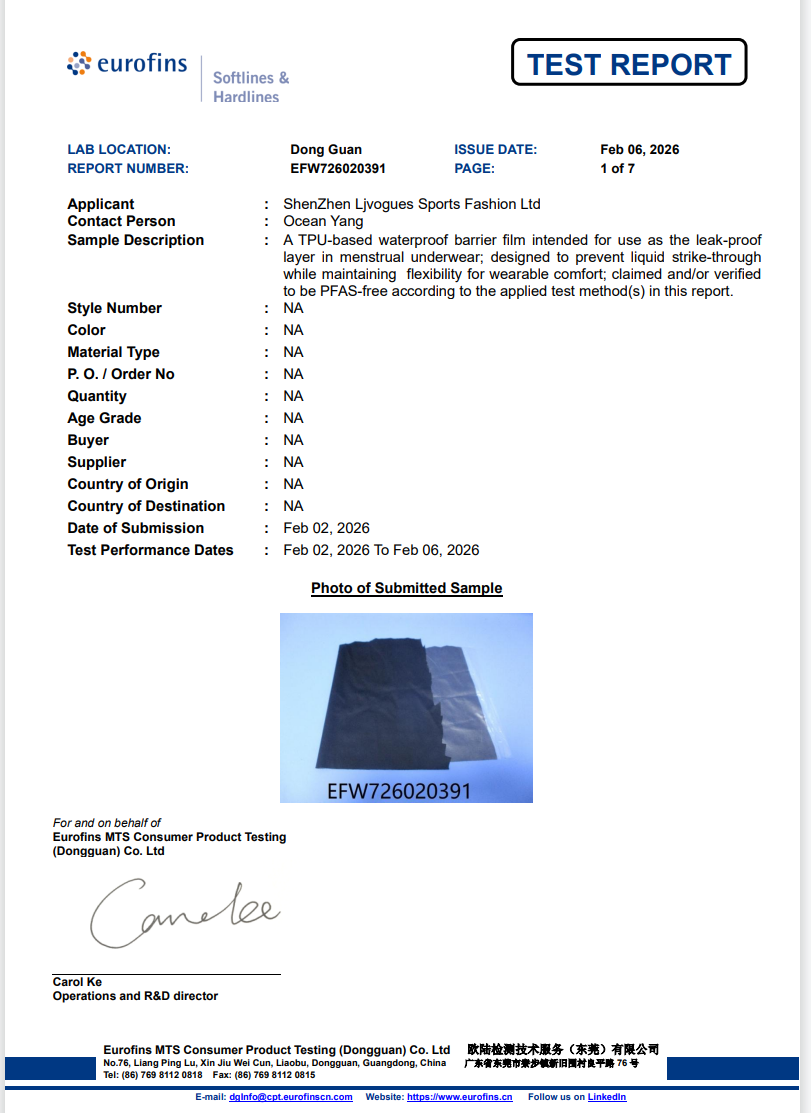
Yes. A period underwear manufacturer can support serious customization when it can control fabric, gusset length, absorbent-layer construction, waterproof coverage, waistband tension, grading, labeling, testing, and packaging as one production system. A buyer may need 5–8 sizes, 3–6 colors, 2–4 absorbency levels, and several fabric combinations, creating dozens of SKUs from one style. In the U.S., textile labels must accurately state fiber content, manufacturer or dealer identity, and country of origin, while fiber-content deviations above 3% can create labeling problems unless unavoidable manufacturing variation can be demonstrated. A capable supplier therefore needs more than sewing capacity; it needs repeatable material control, pattern development, testing, and documented production specifications.
A custom program usually starts with the product structure rather than the logo. Period underwear commonly combines a skin-contact lining, one or more absorbent materials, a liquid-resistant barrier, and the main garment fabric. A brand developing light, moderate, and overnight versions may use the same outer silhouette while changing gusset length, absorbent material weight, barrier coverage, or layer count.
That construction choice affects nearly every later step. Adding one absorbent layer may increase liquid capacity, but it can also increase thickness, drying time, seam bulk, and sewing difficulty. If a factory offers 3 absorbency levels across 6 sizes and 4 colors, one base design can already produce 72 sellable SKU combinations before packaging variations are counted.
A useful supplier discussion starts with measurable requirements: garment measurements, intended wear period, target liquid capacity, gusset coverage, fabric composition, washing method, size range, and expected order quantity.
Fabric development comes next because a pattern cannot be finalized without knowing how the material behaves. Two knits listed as 95% modal and 5% elastane may have different fabric weights, stretch percentages, recovery, shrinkage, surface friction, and opacity. A pattern made for one fabric may fit poorly when transferred to another with lower stretch recovery.
For that reason, buyers should request specifications rather than descriptions such as “premium,” “breathable,” or “soft.” A useful fabric sheet can record composition, GSM, usable width, stretch in warp and weft directions, dimensional change after washing, colorfastness method, pilling result, and supplier lot reference.
The U.S. labeling rules also make fiber accuracy commercially relevant. FTC guidance allows a general manufacturing tolerance of about 3% for stated fiber content, but that tolerance does not permit intentional misstatement. A fabric known to contain 37% cotton should not be labeled 40% cotton simply because the tolerance exists.
That requirement becomes more important when a customized panty combines several textile components. Main body fabric, gusset lining, absorbent layer, elastic, mesh, and decorative components may not all use the same fiber mix, so a manufacturer should maintain material records by component and production lot.
Absorbency development needs the same level of control. Terms such as “light flow” and “heavy flow” are useful for shoppers but too vague for production. One buyer may consider 10 mL suitable for light use while another expects more than 20 mL from the same category, so the specification should state the test method, sample conditioning, liquid type, loading procedure, and pass level.
A manufacturer should therefore be able to compare several constructions using the same test conditions. Testing 5 samples from one construction and 5 from another is more informative than testing one hand-picked sample, because variation between specimens can reveal uneven lamination, absorbent-material inconsistency, or sewing differences.
A practical development table might look like this:
| Development item | Example specification | What should be controlled |
|---|---|---|
| Main fabric | 180–220 GSM stretch knit | weight, stretch, recovery, shrinkage |
| Size range | XS–3XL | graded measurements and tolerance |
| Color range | 4 colors | shade approval and lot consistency |
| Absorbency | 3 performance levels | method, sample count, capacity |
| Gusset | front-to-rear coverage | width, length, layer placement |
| Production check | 5–10 pieces per selected batch | measurement, sewing, appearance |
| Packaging | single or multipack | barcode, size, care and fiber details |
Once absorbency is defined, gusset geometry becomes easier to engineer. A 20 mm change in width can alter coverage around the body, while extending rear protection by 50–100 mm can improve overnight coverage but change how the back panel stretches. Length should therefore be checked on the body rather than approved from a flat technical drawing alone.
Grading makes the issue more complex. A gusset that works in size M should not automatically be copied into 2XL without reviewing placement and width. If the garment grows by 15–25% through the upper size range while the absorbent area barely changes, protective coverage may become proportionally smaller.
Manufacturers with pattern-making staff can adjust both garment dimensions and functional-zone placement across the range. A 7-size collection from XS to 3XL may therefore require separate graded coordinates for the front gusset point, rear endpoint, crotch width, waist, hip, rise, and leg opening rather than one simple scale percentage.
Fit sampling should follow that grading work. One sample on one model cannot establish fit across 7 sizes. Brands with broader ranges often obtain better information by reviewing at least 3 representative sizes, such as a lower, middle, and upper size, before approving the complete grade.
A similar approach applies to waistband tension. Increasing elastic extension by only a few percentage points can noticeably change pressure at the waist. A waistband that looks correct on a table may roll, dig into the body, or loosen after repeated washing if elastic recovery is not checked.
Measurements should be recorded both relaxed and under an agreed stretch condition. “Waist 70 cm” is incomplete if one supplier measures the garment flat and another measures the elastic under tension.
Sampling also needs wash verification because period underwear is repeatedly laundered. The U.S. FTC Care Labeling Rule requires textile wearing apparel manufacturers and importers to provide regular care instructions that remain attached and legible during the product's useful life. The care method should therefore reflect what the finished garment can actually tolerate.
A factory may test dimensions before washing and after 1, 5, 10, or more cycles, depending on the development plan. Even 3% dimensional shrinkage can change fit in a close-fitting garment, particularly around the rise and leg opening, so brands should specify acceptable change rather than relying on visual inspection.
Waterproof-layer durability should be checked during the same process. Lamination, membrane films, adhesives, or coated materials can behave differently after repeated detergent exposure and mechanical agitation. A sample that resists leakage when new may perform differently after 20 washes if bonding quality is inconsistent.
Chemical and material requirements are another part of customization, especially for brands selling in the U.S. or Europe. Buyers sometimes request OEKO-TEX STANDARD 100 certification or material testing, but a certificate should be checked against the actual material and product scope rather than treated as a general factory certificate.
OEKO-TEX updated several requirements in 2025, including a 25 µg/kg PFOS limit for STANDARD 100 and related programs, while additional PFAS-related testing changes continued into 2026. A manufacturer sourcing functional membranes, finishes, adhesives, or printed materials should therefore be able to identify which components are covered by current test documentation.
Material claims also need careful handling. If a brand wants “organic cotton,” “recycled nylon,” or another defined claim, the supplier should provide supporting documentation that applies to the actual production material. A certificate for a different mill article, previous fabric, or unrelated finished product does not establish the specification of the current order.
After materials are approved, production tolerances need to be written into the technical pack. Apparel factories cannot reproduce every dimension to zero variation, so the buyer and supplier usually agree allowable ranges by measurement point.
For example, a waist or hip measurement may allow a limited centimeter tolerance while gusset placement may need tighter control because a misplaced functional panel affects use rather than appearance alone. A batch of 2,000 pieces with a 15 mm gusset-position shift is still 2,000 repeated construction errors even if the sewing itself is neat.
Inspection sampling can reduce that risk. Rather than checking only the first piece, production teams can inspect selected units during sewing and again after finishing. A 5% internal check on a 2,000-piece order would involve 100 garments, providing a broader picture of measurement, stitching, stains, labeling, and packaging consistency.
Branding adds another set of variables. A custom waistband may require its own yarn, loom setup, width, logo repeat, stretch specification, and minimum order, while a heat-transfer mark can often be added in smaller quantities. The more custom components a product contains, the more upstream minimums influence the factory MOQ.
For example, a brand ordering 1,200 pieces across 4 colors and 6 sizes has an average of only 50 units per color-size combination. If a custom fabric mill requires 300 meters per color, the fabric minimum may matter more than the sewing factory's stated garment MOQ.
This is where an experienced supplier such as Ljvogues should be assessed at component level: whether fabric, elastic, absorbent materials, labels, packaging, and graded patterns can all be sourced or produced at quantities that fit the planned order.
SKU planning can reduce unnecessary cost. A first run with 2 styles, 3 colors, and 6 sizes already creates 36 SKUs. Adding 3 absorbency options raises the theoretical total to 108. Unless sales volume supports that range, smaller quantities per SKU can make material purchasing, production scheduling, inspection, and inventory harder to manage.
Packaging specifications should therefore be set after the assortment is stable. Each size-color combination may require its own barcode, size sticker, carton ratio, or retail label, and a packing error can place an otherwise correct garment under the wrong SKU.
U.S. textile rules also require covered products to identify fiber composition, the manufacturer or responsible dealer, and country of origin. Fibers representing 5% or more of total fiber weight generally need to be identified by generic name, with specific rules applying to fibers present at lower percentages.
Care information has its own requirements. Under 16 CFR Part 423, manufacturers and importers must attach care instructions to textile wearing apparel, and if packaging prevents shoppers from seeing the care label, the care information must also be available on the package or a hangtag.
Those regulatory details should be resolved before thousands of labels are printed. Changing a care label after 5,000 units are packed can require reopening every package, removing or covering the old label, applying the corrected version, and conducting another packing inspection.
Costing becomes more accurate once all specifications are fixed. A useful quotation separates garment fabric, gusset materials, elastic, trims, labels, sewing, packaging, testing, and any custom-development charge instead of presenting one unexplained unit price.
A 7% unit-price difference between two suppliers may disappear if one quotation includes custom elastic and testing while the other assumes stock elastic and no third-party test. Buyers comparing prices should therefore send each factory the same technical pack, order quantity, color split, size ratio, packaging specification, and testing requirements.
Lead time should be broken down in the same way. Stock-fabric sampling can move quickly, while custom dyeing, custom elastic, printed packaging, laboratory testing, and multiple fit rounds add separate stages. A project containing 4 custom colors, 7 sizes, and a new gusset construction requires more coordination than relabeling an existing style.
A capable manufacturer should be able to show where each approval sits in the production sequence: fabric approval before cutting, size-set approval before full grading release, packaging approval before mass printing, and pre-production confirmation before bulk sewing.
For buyers, the most useful supplier questions are measurable rather than promotional:
-
Can the factory modify gusset width, length, layer order, and waterproof coverage?
-
How many sizes can be graded from a new base pattern?
-
What dimensional tolerance is used for each measurement point?
-
How many samples are tested for absorbency and washing?
-
Can test reports be linked to the exact fabric or finished construction?
-
Is MOQ calculated per style, color, material, or total order?
-
What percentage of production is checked during and after sewing?
-
How are shade differences between fabric lots controlled?
-
Which specifications are frozen before bulk cutting?
-
How are failed pieces recorded and reworked?
A supplier that can answer those questions with sample records, measurement sheets, test methods, material references, and production tolerances is better prepared for a customized program than one that only offers a large catalog.
For a collection with 6 sizes, 4 colors, and 2 absorbency levels, even one style creates 48 commercial combinations. Maintaining consistent fabric, fit, absorbency, labeling, and packaging across all 48 requires documented specifications and repeatable factory controls rather than informal sample approval.
Customization is most reliable when every feature can be expressed as a material specification, measurement, tolerance, test condition, or approved reference sample. That gives the manufacturer something it can reproduce from batch to batch and gives the buyer something it can inspect before shipment.